Solution
More Than 20 Professional Technicians Service for You
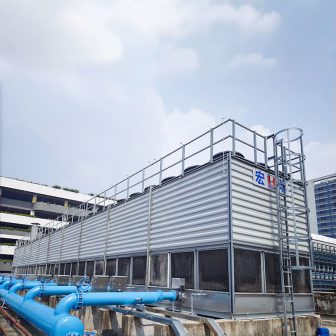
Cooling towers are the backbone of industrial process cooling and commercial HVAC systems. Whether it's a semiconductor fabrication plant, a five-star hotel, a data center, or a chemical processing facility - when thermal management is mission-critical, the cooling tower sits at the very center of the operation.
Yet in many projects, cooling tower selection is treated as a commodity decision: pick the cheapest unit that meets the tonnage spec and move on. That approach is expensive. A suboptimal cooling tower doesn't just cost more upfront — it bleeds money through inflated energy bills, excessive water consumption, unplanned downtime, and shortened equipment life for years, sometimes decades.
Cooling tower technology has advanced dramatically. Modern high-efficiency fill media, precision water distribution, AI-driven controls, and adiabatic pre-cooling can deliver double-digit improvements in both energy and water performance. This guide walks you through everything you need to know — from first-principles sizing to lifecycle economics.
1.Start with the Fundamentals: Three Parameters You Must Get Right
1.1 Heat Rejection Load
Calculate the total heat rejection requirement in kW or refrigeration tons (RT). For water-cooled chiller systems, the cooling tower must reject the chiller's evaporator load plus the compressor heat of compression — typically 1.25 times the chiller's nominal capacity. Add 10–15% margin for future expansion and fouling allowance. Undersizing at this stage cascades into performance failures that no amount of operational tuning can fix.
1.2 Design Wet-Bulb Temperature
The wet-bulb temperature (WBT) at your project site is the single most important environmental parameter for cooling tower design. A tower sized for 26°C WBT will not meet specification at a site where summer WBT peaks at 29°C. Always use the ASHRAE 1% or 2% annual design condition — not the annual average. This is non-negotiable for critical applications.
1.3 Water Quality
Source water chemistry drives material selection, water treatment strategy, and the maximum achievable cycles of concentration. High levels of TDS, silica, or chlorides demand corrosion-resistant construction — SS304 or SS316 stainless steel, fiber-reinforced plastic (FRP), or zinc-magnesium alloy plating. If the process loop must remain contamination-free, a closed-circuit configuration becomes essential.
2. Cooling Tower Types: Match the Technology to Your Application
| Tower Type | Best Application | Key Advantage |
| Open Cross-Flow | Large HVAC, district cooling, power generation | Lowest first cost, easy maintenance access |
| Open Counter-Flow | Space-constrained sites, industrial process | Smaller footprint, higher thermal density |
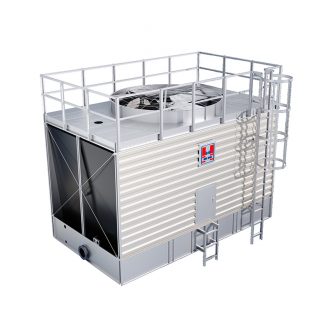
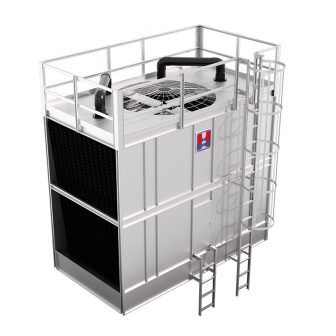
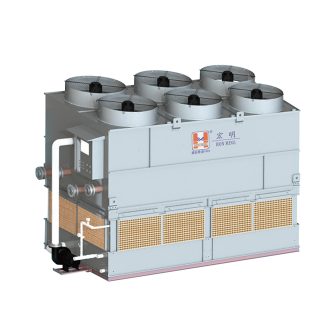
| Closed Circuit | Clean process loops, data centers, food & pharma | Zero contamination risk, freeze protection |
| Adiabatic Closed | Water-scarce regions, high ambient temperature | Up to 50% water savings, no visible plume |
| Round FRP | Small-to-medium commercial, retrofit | Compact, fully corrosion-proof, low maintenance |
Our take: For most industrial projects with adequate space, open cross-flow towers with high-efficiency fill and equal-volume water distribution deliver the best total cost of ownership. For water-sensitive or contamination-critical applications, adiabatic closed cooling towers are rapidly replacing traditional closed-circuit designs — cutting water consumption by up to 50% while maintaining tight approach temperatures even in peak summer conditions.
3. Four Technologies That Deliver Real Payback
Traditional gravity-fed spray systems suffer from inherent imbalance: nozzles near the inlet receive high flow while far-end nozzles starve. The result is dry spots in the fill, wasted heat exchange surface, and degraded performance. EC equal-volume distribution uses precision-engineered basins and calibrated nozzles to deliver uniform water flow across every square meter of fill. Independent testing confirms up to 15% improvement in cooling capacity at the same tower footprint — meaning you either get more cooling from the same footprint, or the same cooling from a smaller, lower-cost unit.
Modern PVC and PP structured fills with optimized honeycomb geometries offer 30–40% more surface area per unit volume compared to legacy splash-grid designs. Combined with precisely angled flute designs that maximize air-water contact time, this translates directly to lower approach temperatures — typically 3–4°C approach under design conditions, versus 5–7°C with older fill technology.
Variable frequency drives on fans and pumps are now baseline equipment. The breakthrough is AI-driven predictive optimization that continuously adjusts fan speed, pump flow, and blowdown cycles based on real-time load, weather forecasts, and equipment condition. Field data from HON MING AI-controlled installations shows 12–20% annual energy reduction and 15–25% water savings compared to fixed-speed operation — while also predicting maintenance needs before they become downtime events.
Zinc-Magnesium (Zn-Mg) alloy plates:
Zinc-Magnesium (Zn-Mg) alloy plates:
FRP (Fiber Reinforced Plastic):
SS304 / SS316 stainless steel:
4. Configuration Checklist: What to Specify
| Parameter | What to Verify |
| Approach temperature | Cold water outlet temperature minus design WBT; 3–4°C is achievable with modern fill |
| Fan power efficiency | kW per ton of cooling; always specify VFD-ready motors |
| Drift loss | <0.005% with high-efficiency drift eliminators |
| Noise limits | Specify maximum dBA at property boundary; ultra-low-noise fans available for urban sites |
| Makeup water management | Target cycles of concentration; verify chemical or non-chemical treatment compatibility |
| Winter operation | Basin heaters, variable-speed fans, or dry/wet switching for sub-zero climates |
| Service access | Internal walkways, removable fill sections, crane access paths for major maintenance |
5. The Real Cost: Lifecycle Economics
A cooling tower typically operates for 15–25 years. The purchase price accounts for only 5–10% of total lifecycle cost. The bulk of your money goes to energy and water — year after year.
Scenario: 500 RT industrial installation (15-year lifecycle)
| Budget Tower | Premium High-Efficiency Tower | Savings | |
| Annual energy cost | $78,000 | $62,000 | $16,000/yr |
| Annual water cost | $32,000 | $22,000 | $10,000/yr |
| 15-Year Total Cost | $1,650,000 | $1,260,000 | $390,000 |
The premium tower pays back the price difference in under 18 months and generates nearly $400,000 in net savings over its lifetime — before accounting for reduced maintenance costs and longer service intervals. Cheap towers are the most expensive choice you can make.
6. Why HON MING
With over 34 years of manufacturing experience and 150,000 m² of production facilities, HON MING has delivered cooling tower solutions for landmark projects worldwide — including Changsha International Conference Center (in partnership with YORK chillers), Hilton Hotels, and mission-critical industrial facilities across Southeast Asia, the Middle East, and Africa.
What you get with HON MING:
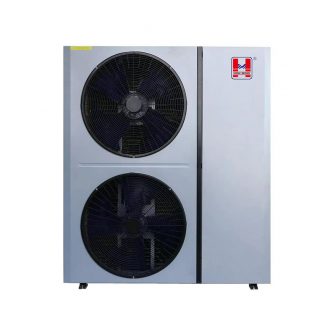
Complete product range:
Proprietary EC equal-volume distribution:
AI intelligent control platform:
Material flexibility:
Full lifecycle support:
7. Your Next Step
Choosing a cooling tower is a high-stakes engineering decision. We make it straightforward.
Send us your project parameters — cooling load, site wet-bulb temperature, water quality data, and any space or noise constraints — and our engineering team will return a custom thermal design proposal, equipment recommendation, and lifecycle cost analysis within 48 hours.